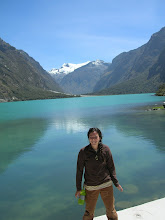
sábado, 30 de enero de 2010

domingo, 10 de enero de 2010
Christmas in Peru
Aside from pig rangling, my past two weeks have been quite eventful, not so much from work productivity, but more so with Christmas and New Year’s festivities in my community. Since I was not home for Christmas, I was determined to share some of my customs with my family and friends, as well as learn and experience very Catholic, very Peruvian tradition as well. The holiday season started off in Huaraz, in an early holiday celebration with some of the other Peace Corps volunteers from Ancash. We all contributed to a potluck dinner (I made a very tasty, very hearty Minestrone) and bought a S/. 10 gift to put into a Yankee swap. With no little more than U.S. $3.33, I bought a lucky recipient a bottle of champagne and a mysterious bottle of passion fruit vodka soda, which any high school student would probably kill for, but may turn out to have traces of strychnine. No toxicologists were present, luckily, and no one turned out blind at the end of the night. While we all enjoyed our gifts and early Christmas dinner,

I brought out the Yule log, to the enjoyment of my fellow volunteers. While in Huaraz, I took advantage of the opportunity to head to the market, and decided that my gift to my host family would be baking them a large amount of Christmas cookies. The challenge with baking is that we do not have an oven, we use a wood stove to cook all of our food. Because we have electricity, I bought a very cheap, U.F.O shaped oven, which is literally an Easy Bake Oven for grown ups. With its electric plug, my lovely little oven reaches only one mystery temperature, but this seems to work fine to bake cookies. Finding ingredients to bake and paint sugar cookies turned out to be quite a scavenger hunt in Huaraz. Although every stand and every tienda sell exactly the same thing, it turns out that they keep up the competitive edge by carrying one different ingredient at any given time. Between about 25 feet of walking and three separate tiendas, I searched and found at each one powdered sugar, food colouring, and all purpose flour. Huaraz never disappoints, you just need patience.
Back in Huashao on Christmas eve, I plugged in the oven and began baking sugar cookies, as well as made white chocolate walnut fudge, chocolate oatmeal peanut butter cookies and old fashioned banana pudding. For Christmas eve, I baked cookies while sitting with my extended Peruvian family in the kitchen and eating boiled corn, Panetton (fruit cake),

drinking hot chocolate and watching the Polar Express. After we all decided to call it a night, I went to my room with trays and trays of sugar cookies to paint. I do not recommend painting sugar cookies in your bedroom to anyone. Although it turns out to be fun, it is equally disastrous, resulting in powdered sugar all over your body, frosting on your blankets, and kicking

over glasses of mulled wine, that are much better drank than dyeing the cement floor. As well as destroying my habitation, I decorated my 1 ½ foot Christmas tree with recycled ornaments I made, and watched a Muppet Christmas Carol, in Spanish or course.
Christmas morning I slept to the robust, late hour of 8:00am, and went straight down to my rock (where I have cell phone reception, sometimes) and called my family in the U.S. to wish everyone a Merry Christmas. On my walk back to my house, my neighbors pulled me into their home, and proceeded to feed me a large bowl of chocho, a tasty, yet dangerous, white bean salad, a large bowl of wheat soup and a fermented corn drink called chicha. I call chocho dangerous because it most certainly is one of the more dangerous food items you can eat when keeping your gastrointestinal system in mind. In order to prepare chocho, it takes three days of sitting in running water, in this case, in the river. When considering that any untreated water here is home to at least giardia, this prospect will make you cringe with every delicious bite you eat. Ah well, being polite sometimes means inviting in the parasites. After escaping more food from the neighbors, I went to my Peruvian grandmother’s house, to eat a huge lunch, including more chocho of course, before the annual Navidad procession.

The Navidad procession is the parade in which the entire community reunites, with a baby Jesus statue on a platter of flowers, to walk it about 1 ½ miles down the main (and only) street down onto the church. Each community member is invited to carry Jesus on his platter for a period of time, and I was not an exception to this invitation.

On Christmas 2009, at about 2:00pm, I carried a statue of baby Jesus (wearing of course a silver dress that reminded me of David Bowie and aliens) on a platter covered with flowers, as my fellow community members threw flower petals in my path and encouraged me to drink chicha out of a rusty bucket with a communal mug. After the procession, we all poured into the church, and although I am not Catholic, or

anything for that matter, I attended my first Christmas mass. Christmas mass in a rural Andean community is held half in Spanish, half in Quechua, to make sure that everyone understands what is going on. The church can only sit about 20 people, which resulted in it being mostly a standing room audience. To finish off my first Christmas in Peru, we all went back home to eat a large amount of potatoes (a Peruvian delicacy and staple) and piccarrones, pieces of fried dough that is soaked in sweetened sedron (a lemon balm like herb) water.
The next morning, from the combination of large amounts of food, parasite infected protein rich beans, fermented corn refreshments from rusting buckets, and the gifts from the three wise men, I was sick for the day. Merry Christmas, from Peru.

I brought out the Yule log, to the enjoyment of my fellow volunteers. While in Huaraz, I took advantage of the opportunity to head to the market, and decided that my gift to my host family would be baking them a large amount of Christmas cookies. The challenge with baking is that we do not have an oven, we use a wood stove to cook all of our food. Because we have electricity, I bought a very cheap, U.F.O shaped oven, which is literally an Easy Bake Oven for grown ups. With its electric plug, my lovely little oven reaches only one mystery temperature, but this seems to work fine to bake cookies. Finding ingredients to bake and paint sugar cookies turned out to be quite a scavenger hunt in Huaraz. Although every stand and every tienda sell exactly the same thing, it turns out that they keep up the competitive edge by carrying one different ingredient at any given time. Between about 25 feet of walking and three separate tiendas, I searched and found at each one powdered sugar, food colouring, and all purpose flour. Huaraz never disappoints, you just need patience.
Back in Huashao on Christmas eve, I plugged in the oven and began baking sugar cookies, as well as made white chocolate walnut fudge, chocolate oatmeal peanut butter cookies and old fashioned banana pudding. For Christmas eve, I baked cookies while sitting with my extended Peruvian family in the kitchen and eating boiled corn, Panetton (fruit cake),

drinking hot chocolate and watching the Polar Express. After we all decided to call it a night, I went to my room with trays and trays of sugar cookies to paint. I do not recommend painting sugar cookies in your bedroom to anyone. Although it turns out to be fun, it is equally disastrous, resulting in powdered sugar all over your body, frosting on your blankets, and kicking

over glasses of mulled wine, that are much better drank than dyeing the cement floor. As well as destroying my habitation, I decorated my 1 ½ foot Christmas tree with recycled ornaments I made, and watched a Muppet Christmas Carol, in Spanish or course.
Christmas morning I slept to the robust, late hour of 8:00am, and went straight down to my rock (where I have cell phone reception, sometimes) and called my family in the U.S. to wish everyone a Merry Christmas. On my walk back to my house, my neighbors pulled me into their home, and proceeded to feed me a large bowl of chocho, a tasty, yet dangerous, white bean salad, a large bowl of wheat soup and a fermented corn drink called chicha. I call chocho dangerous because it most certainly is one of the more dangerous food items you can eat when keeping your gastrointestinal system in mind. In order to prepare chocho, it takes three days of sitting in running water, in this case, in the river. When considering that any untreated water here is home to at least giardia, this prospect will make you cringe with every delicious bite you eat. Ah well, being polite sometimes means inviting in the parasites. After escaping more food from the neighbors, I went to my Peruvian grandmother’s house, to eat a huge lunch, including more chocho of course, before the annual Navidad procession.

The Navidad procession is the parade in which the entire community reunites, with a baby Jesus statue on a platter of flowers, to walk it about 1 ½ miles down the main (and only) street down onto the church. Each community member is invited to carry Jesus on his platter for a period of time, and I was not an exception to this invitation.

On Christmas 2009, at about 2:00pm, I carried a statue of baby Jesus (wearing of course a silver dress that reminded me of David Bowie and aliens) on a platter covered with flowers, as my fellow community members threw flower petals in my path and encouraged me to drink chicha out of a rusty bucket with a communal mug. After the procession, we all poured into the church, and although I am not Catholic, or

anything for that matter, I attended my first Christmas mass. Christmas mass in a rural Andean community is held half in Spanish, half in Quechua, to make sure that everyone understands what is going on. The church can only sit about 20 people, which resulted in it being mostly a standing room audience. To finish off my first Christmas in Peru, we all went back home to eat a large amount of potatoes (a Peruvian delicacy and staple) and piccarrones, pieces of fried dough that is soaked in sweetened sedron (a lemon balm like herb) water.
The next morning, from the combination of large amounts of food, parasite infected protein rich beans, fermented corn refreshments from rusting buckets, and the gifts from the three wise men, I was sick for the day. Merry Christmas, from Peru.
domingo, 13 de diciembre de 2009
Happy Holidays
Happy Holiday season and happy mid-December! Yesterday I bought myself a Christmas tree in a market in Huaraz, and I am extremely excited to bring it back with me to site to decorate it with random stuff I make from my recycled bottles! It is a huge mother of a tree, standing at its epic stature of about 1 ft high, ready to be decorated for my first Peruvian Christmas (and my first Christmas away from home). I have not really felt homesick up to now, but I will probably be a bit sentimental on Christmas when I am up in Huashao with my little tree. I have some wonderful tidings to keep me happy however, and I have been enjoying a large box of oatmeal cookies (compliments of Nana and her excellent baking skills) with a huge carton of cold milk.
My Thanksgiving was spent here in Huaraz also (my regional capital city) with about 10 other senior volunteers. We found a 20lb turkey in the market and paid a bakery to use their ovens to cook our beast. The baker gave us our turkey and promised that it was done, but it unsurprisingly had some pinkish raw spots that we decided to avoid for the sake of preventing any other parasitic friends that

would like to colonize our bodies. Another volunteer was sent a package full of Thanksgiving decorations, stove top, and cranberry sauce, so we all had some funny random pieces of Americana thrown into our celebrations. After our feast and tons of desserts, we went to a bar called the Old West, where the owner's brother in law is from Montana. The bar is full of trucker hats, American beer cans (but no American beer) and western memorabilia. In my merrymakings, I found a Sierra Forest Products hat, and was thrilled to tote it around for the evening. It was a wonderful place to end up at the end of Thanksgiving dinner.

This past week has been kind of difficult for me. In my first two weeks in site, my young host sister had been assaulted by a cab driver, and after taking her to the hospital my family had been in and out of the closest city (Yungay) to go to the police department and court and other such things. I am not really sure what happened or what is still going on, because everyone speaks Quechua, but I am just worried about my host sister and her well being. I am also doing the best I can to stay out of the way while trying to maintain and discover my place here, which has made things very difficult and very awkward for my first few weeks in site. Things seem to be calming down and everyone seems in good spirits, so I hope everything will work out soon and my family can relax. On top of all of that, I have had my first parasite, Giardia. I treat every drop of water that I drink, I am moderately careful with my food and I dont pick up piles of dirt and eat them, but the beauty of the Peace Corps is that we will be getting these lovely friends of our gastrointestinal system frequently. For four days, I was restricted to my bed, and had a very difficult time eating, drinking or standing up for more than 5 minutes. My diet consisted of bread, oatmeal and oral rehydration salts (which are disgusting
). On my first morning of being ill, I went with my family to roof a house of one of our neighbors. During the roofing, the men work on the house and the women prepare food and drink for everyone present. The traditional meal during these gatherings is caldo de cabeza, from the sheep that had been slaughtered that week. Sitting at a table struggling to only drink water, I was faced with a large bowl of broth, head, tripes of different sizes and unrecognizable organs. I generally grin and bear it and eat whatever is placed in front of me here, but being sick and seeing that many stewed organs just made me feel worse. Yet, I was still very appreciative for their offer, and drank some of the broth.
During my days I have been trying to establish my presence with the local school, which has been a constant struggle as well. The school is soon to go on vacations for the next two months, therefore I am trying to get in to do summer classes or a summer camp program that is focused on environmental science, English (which I do not want to teach but there is a strong interest), and health sessions. The director of the school has been very difficult and unresponsive, yet I will continuously try to get a foot into the door and break some ground there. I am also contacting World Vision, an NGO that works in the area, to see if I can team up with them on their programs and have a time slot for my own sessions. We shall see, we shall see.
Another school that I have visited, Humacchuco, has been extremely responsive and very interested in inviting me to their school. Their school is very strongly focused on ecology and environmental science, so working here would be a great opportunity for me to teach environmental science sessions to a group of interested students. The school has been visited and funded by a Canadian doctor, who has pushed their environmental focus, and in 1996, donated a flock of sheep for the students. The students here shear the sheep, dye the wool with local plants and flowers, and sell handicrafts to the tourists that pass through our area. After visiting my school in Huashao and leaving cursing and stewing, I walked up to Humacchuco, and was met by a breath of fresh air and some seemingly great opportunities (I also found a 4 leaf clover before going into the school).
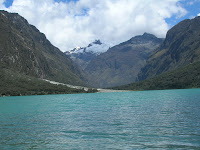
On some weekdays, I hike up to the park and meet with the guardaparques (park guards) to try to establish a presence in the park as well. My counterpart is the boss of this section of the park, but he is currently in Bolivia for a conference. Without him being here, there is not very much that I can do, except introduce myself to the other few people that work in the park. For all of Husacaran National Park, which has the largest concentration of tropical glaciers in the world and covers a huge area, there are only 12 park guards. Many of them work at the post of control near my community, because this is the main entrance way into this part of the Cordillera Blanca and is a huge starting point for many of the most popular treks here in Peru. Also, I just like coming to Laguna Chinancocha to sit and read a nice book, and relax for a bit. Good times.

On Friday, I came into Huaraz for a training class offered by SERNANP (servicios nationales areas naturales protegidas)which is the agency that manages national parks and reserves in Peru. The director from the school in Humacchuco and a science teacher from my school in Huashao joined me for the 10 hour course. The course was offered to all schools within the buffer zone of the Huascaran bioreserve, in order to include courses about park flora, fauna, management and general information. Because we all live within the bioreserve, this information is critical to the students and people of these communities, and not only will it increase local pride in their natural resources, but will also be a great educational tool to encourage land stewardship and sustainable environmental management. On another note, the national park service owns a spectacled bear suit, and since he is their mascot, one of the techs was dressed up and set out to dance in front of us to a jingle about the bioreserve. Because I was the only gringa among about 40 teachers, I was sent up to the stage to dance with the dancing spectacled bear. I still cannot dance cumbia, especially not in front of a huge group of teachers. Also, after our training course was finished, a group of school children were invited to present to us a puppet show about spectacled bears. I am very very happy that puppet shows are a big thing here, because I will surely funnel some of my environmental education abilities into some fantastic puppet shows. During the puppet show, we were treated to another person dressed as a spectacled bear, but this time it was a singing and dancing eight year old, and it was awesome.
I apologize if my English skills are getting progressively worse. I know they are, and it is most likely very evident here. My mind is a mixture of Spanish, Quechua and at times like these English, therefore my grammar is destroying itself. Enjoy the downward spiral of my linguistic skills as you continue to read in the future. Oh and Happy Holidays!!! Don't forget to keep those less fortunate in mind now and at other times of the year. There are always millions of local organizations collecting food and clothing for people in need in our areas in the U.S. Also, if you are sick of buying useless gifts for your friends, you can buy livestock for a family in a developing country for a small price, from a great organization. Here is the link http://www.heifer.org/site/c.edJRKQNiFiG/b.204586/
My Thanksgiving was spent here in Huaraz also (my regional capital city) with about 10 other senior volunteers. We found a 20lb turkey in the market and paid a bakery to use their ovens to cook our beast. The baker gave us our turkey and promised that it was done, but it unsurprisingly had some pinkish raw spots that we decided to avoid for the sake of preventing any other parasitic friends that

would like to colonize our bodies. Another volunteer was sent a package full of Thanksgiving decorations, stove top, and cranberry sauce, so we all had some funny random pieces of Americana thrown into our celebrations. After our feast and tons of desserts, we went to a bar called the Old West, where the owner's brother in law is from Montana. The bar is full of trucker hats, American beer cans (but no American beer) and western memorabilia. In my merrymakings, I found a Sierra Forest Products hat, and was thrilled to tote it around for the evening. It was a wonderful place to end up at the end of Thanksgiving dinner.

This past week has been kind of difficult for me. In my first two weeks in site, my young host sister had been assaulted by a cab driver, and after taking her to the hospital my family had been in and out of the closest city (Yungay) to go to the police department and court and other such things. I am not really sure what happened or what is still going on, because everyone speaks Quechua, but I am just worried about my host sister and her well being. I am also doing the best I can to stay out of the way while trying to maintain and discover my place here, which has made things very difficult and very awkward for my first few weeks in site. Things seem to be calming down and everyone seems in good spirits, so I hope everything will work out soon and my family can relax. On top of all of that, I have had my first parasite, Giardia. I treat every drop of water that I drink, I am moderately careful with my food and I dont pick up piles of dirt and eat them, but the beauty of the Peace Corps is that we will be getting these lovely friends of our gastrointestinal system frequently. For four days, I was restricted to my bed, and had a very difficult time eating, drinking or standing up for more than 5 minutes. My diet consisted of bread, oatmeal and oral rehydration salts (which are disgusting
). On my first morning of being ill, I went with my family to roof a house of one of our neighbors. During the roofing, the men work on the house and the women prepare food and drink for everyone present. The traditional meal during these gatherings is caldo de cabeza, from the sheep that had been slaughtered that week. Sitting at a table struggling to only drink water, I was faced with a large bowl of broth, head, tripes of different sizes and unrecognizable organs. I generally grin and bear it and eat whatever is placed in front of me here, but being sick and seeing that many stewed organs just made me feel worse. Yet, I was still very appreciative for their offer, and drank some of the broth.
During my days I have been trying to establish my presence with the local school, which has been a constant struggle as well. The school is soon to go on vacations for the next two months, therefore I am trying to get in to do summer classes or a summer camp program that is focused on environmental science, English (which I do not want to teach but there is a strong interest), and health sessions. The director of the school has been very difficult and unresponsive, yet I will continuously try to get a foot into the door and break some ground there. I am also contacting World Vision, an NGO that works in the area, to see if I can team up with them on their programs and have a time slot for my own sessions. We shall see, we shall see.
Another school that I have visited, Humacchuco, has been extremely responsive and very interested in inviting me to their school. Their school is very strongly focused on ecology and environmental science, so working here would be a great opportunity for me to teach environmental science sessions to a group of interested students. The school has been visited and funded by a Canadian doctor, who has pushed their environmental focus, and in 1996, donated a flock of sheep for the students. The students here shear the sheep, dye the wool with local plants and flowers, and sell handicrafts to the tourists that pass through our area. After visiting my school in Huashao and leaving cursing and stewing, I walked up to Humacchuco, and was met by a breath of fresh air and some seemingly great opportunities (I also found a 4 leaf clover before going into the school).
On some weekdays, I hike up to the park and meet with the guardaparques (park guards) to try to establish a presence in the park as well. My counterpart is the boss of this section of the park, but he is currently in Bolivia for a conference. Without him being here, there is not very much that I can do, except introduce myself to the other few people that work in the park. For all of Husacaran National Park, which has the largest concentration of tropical glaciers in the world and covers a huge area, there are only 12 park guards. Many of them work at the post of control near my community, because this is the main entrance way into this part of the Cordillera Blanca and is a huge starting point for many of the most popular treks here in Peru. Also, I just like coming to Laguna Chinancocha to sit and read a nice book, and relax for a bit. Good times.


On Friday, I came into Huaraz for a training class offered by SERNANP (servicios nationales areas naturales protegidas)which is the agency that manages national parks and reserves in Peru. The director from the school in Humacchuco and a science teacher from my school in Huashao joined me for the 10 hour course. The course was offered to all schools within the buffer zone of the Huascaran bioreserve, in order to include courses about park flora, fauna, management and general information. Because we all live within the bioreserve, this information is critical to the students and people of these communities, and not only will it increase local pride in their natural resources, but will also be a great educational tool to encourage land stewardship and sustainable environmental management. On another note, the national park service owns a spectacled bear suit, and since he is their mascot, one of the techs was dressed up and set out to dance in front of us to a jingle about the bioreserve. Because I was the only gringa among about 40 teachers, I was sent up to the stage to dance with the dancing spectacled bear. I still cannot dance cumbia, especially not in front of a huge group of teachers. Also, after our training course was finished, a group of school children were invited to present to us a puppet show about spectacled bears. I am very very happy that puppet shows are a big thing here, because I will surely funnel some of my environmental education abilities into some fantastic puppet shows. During the puppet show, we were treated to another person dressed as a spectacled bear, but this time it was a singing and dancing eight year old, and it was awesome.
I apologize if my English skills are getting progressively worse. I know they are, and it is most likely very evident here. My mind is a mixture of Spanish, Quechua and at times like these English, therefore my grammar is destroying itself. Enjoy the downward spiral of my linguistic skills as you continue to read in the future. Oh and Happy Holidays!!! Don't forget to keep those less fortunate in mind now and at other times of the year. There are always millions of local organizations collecting food and clothing for people in need in our areas in the U.S. Also, if you are sick of buying useless gifts for your friends, you can buy livestock for a family in a developing country for a small price, from a great organization. Here is the link http://www.heifer.org/site/c.edJRKQNiFiG/b.204586/
sábado, 28 de noviembre de 2009
Happy Thanksgiving (and my first week as a Peace Corps volunteer)
I know that I have been here for 3 months, however, I have only been a real sworn in Peace Corps volunteer for a week. After 10 weeks of training, we were sworn in by a member of the U.S. Embassy and a health service representative of Peru as Peace Corps volunteers. The oath that we take to become a PCV is pretty much swearing ourselves to the U.S. government, and (in the most peaceful of manners) swear to defend against enemies foreign and domestic. Happily, I have passed my language classes and technical proficiencies, and I am worthy of being a Peace Corps volunteer. Wooty Woo!!!

Becoming a Peace Corps volunteer means that I have also taken that step to leave all of my English speaking fellow trainees, and have moved into my community where I will be living for the next two years. I have successfully completed my first week at site, and I am really looking forward to getting started with projects and writing my community diagnostic over the next three months. The first stage as a Peace Corps volunteer is to do a community analysis, and diagnose the needs of the community. Generally speaking, this means that the next three months will be me introducing myself to the community and doing lots and lots and lots of talking.
For the next two years I will be living in a community of 250 people in a town called Huashao. Huashao is a farming community that is nestled in the buffer zone of Huascaran National Park, and sits in the shadow of Huascaran, the largest
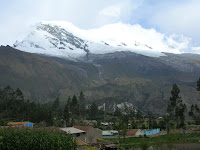
mountain in Peru (and largest tropical glacier in the world) and Huandoy. When the day is clear, I can look out of my bedroom window and see them both towering over the fields.....its pretty lovely. About 1 1/2 hours walk from my house is Laguna Llanganuco, a large glacial lake that is frequently visited by tourists. My host family is a small farming family of the wonderful Jaime, my host father who works construction and in the farm, mother Lucinda, sister Mariela and her 5 year old daughter Sumi (or as I have dubbed her Sumi Saurus, Pishtako, and Dona Cochinona), 16 year old sister Fiorela, and 3 year old brother Jaime.

My host family here is extremely amicable and consistently interested in my happiness and comfort in my new home. My host father is strongly involved in community politics, and has taken me to a community meeting to be introduced to our entire community. Actually, I gave a speech (in Spanish of course) to a large group of community members about my role in Huashao as a PCV, some examples of what I will be doing, and just pretty much warning them that I will be the strange gringa in their community for the next two years. Needless to say, I was terrified and stuttered a bit in Spanish. After my speech, my father spoke on my behalf in Quechua, which resulted in applause and thanks for my presence. Along with my introduction to my community, I met with the principal of the school, to ask for permission to teach a summer camp program during the rainy season (which has begun and will not cease to be until April). The director of the school was slightly stand offish, and I did not realize until later that she had given another PCV trouble about teaching in the school. No matter what, I am going to be extremely perseverant with the school, and somehow get myself in there to teach environmental education, some way, some how.
I have finally finished unpacking and I am starting to write up my interviews and surveys that I want to use to do my community diagnostic. I plan on interviewing community members, community leaders, staff and administration of the national park service, tourists (to invstigate ecotourism), local NGO´s, schools, and local community groups. This should all prove to be hard work, but I feel that it is completely necessary to interview all of these respective groups in order to create programs that are sustainable and directed to my program goals. I am about to get kicked off of the computer, but this week promises to be a busy, work and question filled few days to learn more about my community and my future projects here.

Becoming a Peace Corps volunteer means that I have also taken that step to leave all of my English speaking fellow trainees, and have moved into my community where I will be living for the next two years. I have successfully completed my first week at site, and I am really looking forward to getting started with projects and writing my community diagnostic over the next three months. The first stage as a Peace Corps volunteer is to do a community analysis, and diagnose the needs of the community. Generally speaking, this means that the next three months will be me introducing myself to the community and doing lots and lots and lots of talking.
For the next two years I will be living in a community of 250 people in a town called Huashao. Huashao is a farming community that is nestled in the buffer zone of Huascaran National Park, and sits in the shadow of Huascaran, the largest

mountain in Peru (and largest tropical glacier in the world) and Huandoy. When the day is clear, I can look out of my bedroom window and see them both towering over the fields.....its pretty lovely. About 1 1/2 hours walk from my house is Laguna Llanganuco, a large glacial lake that is frequently visited by tourists. My host family is a small farming family of the wonderful Jaime, my host father who works construction and in the farm, mother Lucinda, sister Mariela and her 5 year old daughter Sumi (or as I have dubbed her Sumi Saurus, Pishtako, and Dona Cochinona), 16 year old sister Fiorela, and 3 year old brother Jaime.

My host family here is extremely amicable and consistently interested in my happiness and comfort in my new home. My host father is strongly involved in community politics, and has taken me to a community meeting to be introduced to our entire community. Actually, I gave a speech (in Spanish of course) to a large group of community members about my role in Huashao as a PCV, some examples of what I will be doing, and just pretty much warning them that I will be the strange gringa in their community for the next two years. Needless to say, I was terrified and stuttered a bit in Spanish. After my speech, my father spoke on my behalf in Quechua, which resulted in applause and thanks for my presence. Along with my introduction to my community, I met with the principal of the school, to ask for permission to teach a summer camp program during the rainy season (which has begun and will not cease to be until April). The director of the school was slightly stand offish, and I did not realize until later that she had given another PCV trouble about teaching in the school. No matter what, I am going to be extremely perseverant with the school, and somehow get myself in there to teach environmental education, some way, some how.
I have finally finished unpacking and I am starting to write up my interviews and surveys that I want to use to do my community diagnostic. I plan on interviewing community members, community leaders, staff and administration of the national park service, tourists (to invstigate ecotourism), local NGO´s, schools, and local community groups. This should all prove to be hard work, but I feel that it is completely necessary to interview all of these respective groups in order to create programs that are sustainable and directed to my program goals. I am about to get kicked off of the computer, but this week promises to be a busy, work and question filled few days to learn more about my community and my future projects here.
miércoles, 4 de noviembre de 2009
Training and Our Awesome Excursions!
Unbelieveably, I am in the middle of my 8th week of training, which means that I am down to a little more than two weeks before moving to my site and new home for the next two years. Right now I am experiencing the same nervous excitement that I felt right before I left the U.S., and now that training is coming to an end I am getting myself ready for the big jump into starting my service. The past two months have been filled with a ton of training and classes to prepare me for my service, and it is actually about to begin on November 21st!
For the past 8 weeks I have spent all of my days in a very cushy training center in Chaclacayo, where we have 8 hours everyday of classes. For 4-5 hours everyday we were split into groups of 4 people for language training, which consisted of immersion based lessons in grammar, vocabulary and conversational Peruvian Spanish. Each day we did lessons and then practiced them with exercises in the community. For example, one day we learned vocabulary words for different foods, and then we were sent into the marketplace with 3 soles to bargain and buy food for the day. It was slightly terrifying some days to get sent out into what felt like the wild blue yonder of the Spanish language, but it forced us to speak Spanish and it made me alot less nervous to talk to native Spanish speakers. For a mini community diagnostic project, I was sent out to interview community members in order to identify the strengths and weaknesses of the community, in order to analyse what they deem as areas of need. For this exercise, I walked around to tiendas, homes and the health post to ask people questions and converse with them about the resources in Chaclacayo. After a long day of interviews and questionnaires, I sat in the conchita to organize my notes, when an older woman of the community came out

of her home with a huge plate of food for me and my partner to eat while we worked. Little invitations like this are huge gestures of acceptance, and it made me realize that although I struggled with the language and was nervous to speak, people still liked me. Ha.
In addition to language training we have had classes on Peruvian history and government, culture, medical and health sessions (which always include new vaccines), security classes, and best of all, technical training. Tech training is where we learn to build organic gardens, manage trash, set up recycling programs, build micro rellenos, build tree nurseries, learn how to reforest, assess natural resources, manage rangeland, develop ecotourism...........I love it. Technical training is in the training center for the duration of the week, but every Saturday we travel to Lima to take classes at Peru´s only agricultural university, La


Agraria. At La Agraria, we are given lectures by different professors on reforestation, organic agriculture, dendrology, irrigation systems and small animal husbandry. After days of classes, my friends and I travel into Lima to visit the museums, catacombs or the bioferria, a fair of organic produce which is awesome! In addition to our university classes, we have been taken on field trips to farming communities and protected areas to introduce us to the two different aspects of our time as protected areas and community based environmental managers.
In the past few weeks, our field based training has been the most exciting and most memorable time of my entire training experience. Our first field trip was a full day excursion to a region called Ayas, a community in the foothills of the Andes

that grows a huge diversity of crops, including alfalfa, chirimoya, apples, San Pedro (not a crop), sauco, corn, and potatoes. Our trip to Ayas was planned to conduct a survey of all of the natural resources of an area, including agricultural and wild, in order to assess the biological health and productivity of the area. As it turns out, as you climb the large hills (if nothing else mountains) of Ayas, you meet three different climate zones, which are home to different types of vegetation and cultivation. Unluckily, Ayas was rich in mineral resources, and due to mining there is a good deal of copper and other heavy metal leachage into the drainages, which then lead to their water sources. Ayas was also home to beautiful forests of high elevation tree species, waterfalls, and pre Incan ruins.
Our first trip to a protected area, Lomas de Lachay, is a biological reserve and

wildlife refuge on the coast of Lima. Lomas de Lachay is unique in that it is an entirely vegetated range in the middle of what should be a desert. As you drive to Lomas, you drive along the coast of the department of Lima, which are huge sand hills along the Pacific. As you enter the reserve, everything becomes green, slowly with low lying bushes and then later with larger tree species and wildflowers. Lomas de Lachay lies in the heart of a circle of mountains, and due to its luck of

the draw, it traps the clouds and dew that comes in from the Pacific, creating a sink of humidity that allows the rich vegetation to grow here. A wide diversity of plant and animal species call Lomas de Lachay their home, including a few endemic species as well. Luckily during my day here, I happily spotted a few different hawks and eagles (the species I am uncertain of....still waiting to buy that damn field guide off of Amazon).

During our time in Lomas, we learned about reserve management and challenges from the park guides, and afterwards helped with a reforestation effort and planted 100 trees (native species of course).
Our final single day field trip was to Pantamos de Villa, a RAMSAR site very close to the city of Lima, that is very desperately threatened by human development and industrial pollution. RAMSAR is a program through the United Nations that provides support and funding to protect areas that are deemed as important wetland habitats and important areas for migratory bird species.

Pantamos has received a ton of support and effort from the United Nations, the Peruvian government, environmental organizations and the general population in order to protect and preserve this lasting scrap of land for the wildlife that call it home. Pantamos is a brackish wetland that is separated from the Pacific solely by about 100 yards of a beach, and I am certain that during storm surges much of the saline waters of the Pacific make their way into the brackish waters of Pantamos. Sadly, the surrounding communities around Pantamos illegally try to fill it with desmonte (which is a combination of rock, sand and destroyed cement) in order to make more space for things like soccer fields and flat areas to build. Alot of this illegal dumping is the result of invasions, which are squatter communities that literally invade an area and settle there for a long period of time. After learning about the endless management challenges presented by a wetland in the midst of sprawl, my training group and I headed to the beach for lunch, where about 5 of us proceeded to jump into the ocean in our underwear.
Last week the entire medio ambiente group was sent to Ancash for field based training. For 4 days, we visited sites of existing Peace Corps volunteers, and trained with governmental organizations of Peru as well. Our first stop on the trip was the home of a PCV named James, who has been living in site for about a year now. James lives in the highest site in the whole of the Peace Corps, in the Andes of Ancash. At his site, we were given lectures by AgroRural (the Peruvain equivalent of USDA) on tree nurseries, reforestation, and prime species to use for reforesting high elevation areas. In addition to our lessons, we participated in a reforestation effort in the town, planting native species such as Queñual and Aliso. As our grand professor Fauso was teaching us the proper way to dig a hole at its optimal depth, he came across what seemed to be a large rock. In order to eradicate this problem, he pounded a large metal spike into the ground, with which the first pound of pressure resulted in a huge fountain of water spraying up

from the hole. The rock turned out to be the water lines for the town, which were now punctured by the fury of our reforestation efforts. After a good deal of time looking for community leaders, we finally had the water turned off, and my boss patched up the pipeline. Later that night, I heartily ate my first meal of cuy, aka guinea pig, which is not as exciting as it sounds (it tastes like chicken, like everything else). The next day, we headed to the site of a volunteer named Brian, in a community called Collon. In Collon we taught classes to a group of farmers on different topics about solid waste management. The lesson that I taught was about building micro rellenos, a system of trash management for small rural communities here in the Sierra. After my lecture, we actually built a micro relleno (which consists of digging a deep square hole)

for the community, and then threw in the first few pieces of trash. Our last day of field training in Ancash was the absolute best....because I saw my site and home that I will be living in for the next two years.....but I will elaborate more on that after I do my week long site visit in two days.......Anywho, our last day of field based training consisted of visiting Huascaran National Park and the lovely Laguna Llanganuco (which I will be living about an hour or so walk from for the next two years). In Huascaran we met with the park guides to learn more about park management, trash management and ecotourism challenges in this region in Peru. With the park guide as our teacher, we went on a short hike to learn about some of the high elevation plant species, and he introduced us to a beautiful spot in the park that grew wild Andean orchids.

The orchids here grow in 8 different colours, depending on the altitude. Before we headed out of the park and down to a lodge to learn about ecotourism, my group, which consisted of only six of us, went skinny dipping in the pristine glacial waters of Laguna Llanganuco.

There is a tradition between the Ancash volunteers to skinny dip in as many glacial lakes as possible within two years. The record so far is 12,but because I am going to be an Ancashino for the next two years, I am certain their records are going to be smashed. To end our time in Ancash, we visited an amazing tourist lodge (which is only about 15 minutes from my future site) called Llanganuco Lodge, which is situated on a hill between the glaciers of Huandoy and Huascaran (the highest mountain in Peru). The purpose of our visit here was to meet the British proprietor of this fine establishment, a young accountant turned mountaineer and climber Charlie. Charlie is probably the British equivalent of Hunter S. Thompson, possibly lacking the writing, but complete with the eccentricities and the guns. It was here that we learned about the possibilites and opportunities of ecotourism in Peru, but also the huge challenges that we will face when working with local municipalities and local governments. Along from being a great resource for climbing and mountaineering gear (which I am absolutely and completely stoked about), this lodge has an extensive library, which I will surely be taking advantage of when I go on my runs up the mountain.
All in all, thus far I have loved training for the most part. There are the days when it feels like I have no time to rest or anytime to myself, but the classes are really interesting, the people are great, and I am so absolutely happy to be here. I constantly ask myself how I have been so lucky to have been placed here in Peru (a country that I have been obsessing over for my entire life), in a program that is perfect for me, working on programs that really make me feel fulfilled. Simply, I don´t believe I could be happier right now.
On another note, I just really wanted to thank everyone who has sent me mail! Receiving letters and postcards really makes my day, actually my week, and it always keeps me happy knowing that I am in the minds of people back home. Entonces, I just wanted to say thank you to my family and friends who have sent me letters, postcards, photos, reeses and smartwool socks. I will most definitely be sending you all letters sometime soon. Thank you so much for your support, it is truly appreciated and makes those rough days so much easier.
For the past 8 weeks I have spent all of my days in a very cushy training center in Chaclacayo, where we have 8 hours everyday of classes. For 4-5 hours everyday we were split into groups of 4 people for language training, which consisted of immersion based lessons in grammar, vocabulary and conversational Peruvian Spanish. Each day we did lessons and then practiced them with exercises in the community. For example, one day we learned vocabulary words for different foods, and then we were sent into the marketplace with 3 soles to bargain and buy food for the day. It was slightly terrifying some days to get sent out into what felt like the wild blue yonder of the Spanish language, but it forced us to speak Spanish and it made me alot less nervous to talk to native Spanish speakers. For a mini community diagnostic project, I was sent out to interview community members in order to identify the strengths and weaknesses of the community, in order to analyse what they deem as areas of need. For this exercise, I walked around to tiendas, homes and the health post to ask people questions and converse with them about the resources in Chaclacayo. After a long day of interviews and questionnaires, I sat in the conchita to organize my notes, when an older woman of the community came out

of her home with a huge plate of food for me and my partner to eat while we worked. Little invitations like this are huge gestures of acceptance, and it made me realize that although I struggled with the language and was nervous to speak, people still liked me. Ha.
In addition to language training we have had classes on Peruvian history and government, culture, medical and health sessions (which always include new vaccines), security classes, and best of all, technical training. Tech training is where we learn to build organic gardens, manage trash, set up recycling programs, build micro rellenos, build tree nurseries, learn how to reforest, assess natural resources, manage rangeland, develop ecotourism...........I love it. Technical training is in the training center for the duration of the week, but every Saturday we travel to Lima to take classes at Peru´s only agricultural university, La


Agraria. At La Agraria, we are given lectures by different professors on reforestation, organic agriculture, dendrology, irrigation systems and small animal husbandry. After days of classes, my friends and I travel into Lima to visit the museums, catacombs or the bioferria, a fair of organic produce which is awesome! In addition to our university classes, we have been taken on field trips to farming communities and protected areas to introduce us to the two different aspects of our time as protected areas and community based environmental managers.
In the past few weeks, our field based training has been the most exciting and most memorable time of my entire training experience. Our first field trip was a full day excursion to a region called Ayas, a community in the foothills of the Andes

that grows a huge diversity of crops, including alfalfa, chirimoya, apples, San Pedro (not a crop), sauco, corn, and potatoes. Our trip to Ayas was planned to conduct a survey of all of the natural resources of an area, including agricultural and wild, in order to assess the biological health and productivity of the area. As it turns out, as you climb the large hills (if nothing else mountains) of Ayas, you meet three different climate zones, which are home to different types of vegetation and cultivation. Unluckily, Ayas was rich in mineral resources, and due to mining there is a good deal of copper and other heavy metal leachage into the drainages, which then lead to their water sources. Ayas was also home to beautiful forests of high elevation tree species, waterfalls, and pre Incan ruins.
Our first trip to a protected area, Lomas de Lachay, is a biological reserve and

wildlife refuge on the coast of Lima. Lomas de Lachay is unique in that it is an entirely vegetated range in the middle of what should be a desert. As you drive to Lomas, you drive along the coast of the department of Lima, which are huge sand hills along the Pacific. As you enter the reserve, everything becomes green, slowly with low lying bushes and then later with larger tree species and wildflowers. Lomas de Lachay lies in the heart of a circle of mountains, and due to its luck of

the draw, it traps the clouds and dew that comes in from the Pacific, creating a sink of humidity that allows the rich vegetation to grow here. A wide diversity of plant and animal species call Lomas de Lachay their home, including a few endemic species as well. Luckily during my day here, I happily spotted a few different hawks and eagles (the species I am uncertain of....still waiting to buy that damn field guide off of Amazon).

During our time in Lomas, we learned about reserve management and challenges from the park guides, and afterwards helped with a reforestation effort and planted 100 trees (native species of course).
Our final single day field trip was to Pantamos de Villa, a RAMSAR site very close to the city of Lima, that is very desperately threatened by human development and industrial pollution. RAMSAR is a program through the United Nations that provides support and funding to protect areas that are deemed as important wetland habitats and important areas for migratory bird species.

Pantamos has received a ton of support and effort from the United Nations, the Peruvian government, environmental organizations and the general population in order to protect and preserve this lasting scrap of land for the wildlife that call it home. Pantamos is a brackish wetland that is separated from the Pacific solely by about 100 yards of a beach, and I am certain that during storm surges much of the saline waters of the Pacific make their way into the brackish waters of Pantamos. Sadly, the surrounding communities around Pantamos illegally try to fill it with desmonte (which is a combination of rock, sand and destroyed cement) in order to make more space for things like soccer fields and flat areas to build. Alot of this illegal dumping is the result of invasions, which are squatter communities that literally invade an area and settle there for a long period of time. After learning about the endless management challenges presented by a wetland in the midst of sprawl, my training group and I headed to the beach for lunch, where about 5 of us proceeded to jump into the ocean in our underwear.
Last week the entire medio ambiente group was sent to Ancash for field based training. For 4 days, we visited sites of existing Peace Corps volunteers, and trained with governmental organizations of Peru as well. Our first stop on the trip was the home of a PCV named James, who has been living in site for about a year now. James lives in the highest site in the whole of the Peace Corps, in the Andes of Ancash. At his site, we were given lectures by AgroRural (the Peruvain equivalent of USDA) on tree nurseries, reforestation, and prime species to use for reforesting high elevation areas. In addition to our lessons, we participated in a reforestation effort in the town, planting native species such as Queñual and Aliso. As our grand professor Fauso was teaching us the proper way to dig a hole at its optimal depth, he came across what seemed to be a large rock. In order to eradicate this problem, he pounded a large metal spike into the ground, with which the first pound of pressure resulted in a huge fountain of water spraying up

from the hole. The rock turned out to be the water lines for the town, which were now punctured by the fury of our reforestation efforts. After a good deal of time looking for community leaders, we finally had the water turned off, and my boss patched up the pipeline. Later that night, I heartily ate my first meal of cuy, aka guinea pig, which is not as exciting as it sounds (it tastes like chicken, like everything else). The next day, we headed to the site of a volunteer named Brian, in a community called Collon. In Collon we taught classes to a group of farmers on different topics about solid waste management. The lesson that I taught was about building micro rellenos, a system of trash management for small rural communities here in the Sierra. After my lecture, we actually built a micro relleno (which consists of digging a deep square hole)

for the community, and then threw in the first few pieces of trash. Our last day of field training in Ancash was the absolute best....because I saw my site and home that I will be living in for the next two years.....but I will elaborate more on that after I do my week long site visit in two days.......Anywho, our last day of field based training consisted of visiting Huascaran National Park and the lovely Laguna Llanganuco (which I will be living about an hour or so walk from for the next two years). In Huascaran we met with the park guides to learn more about park management, trash management and ecotourism challenges in this region in Peru. With the park guide as our teacher, we went on a short hike to learn about some of the high elevation plant species, and he introduced us to a beautiful spot in the park that grew wild Andean orchids.

The orchids here grow in 8 different colours, depending on the altitude. Before we headed out of the park and down to a lodge to learn about ecotourism, my group, which consisted of only six of us, went skinny dipping in the pristine glacial waters of Laguna Llanganuco.

There is a tradition between the Ancash volunteers to skinny dip in as many glacial lakes as possible within two years. The record so far is 12,but because I am going to be an Ancashino for the next two years, I am certain their records are going to be smashed. To end our time in Ancash, we visited an amazing tourist lodge (which is only about 15 minutes from my future site) called Llanganuco Lodge, which is situated on a hill between the glaciers of Huandoy and Huascaran (the highest mountain in Peru). The purpose of our visit here was to meet the British proprietor of this fine establishment, a young accountant turned mountaineer and climber Charlie. Charlie is probably the British equivalent of Hunter S. Thompson, possibly lacking the writing, but complete with the eccentricities and the guns. It was here that we learned about the possibilites and opportunities of ecotourism in Peru, but also the huge challenges that we will face when working with local municipalities and local governments. Along from being a great resource for climbing and mountaineering gear (which I am absolutely and completely stoked about), this lodge has an extensive library, which I will surely be taking advantage of when I go on my runs up the mountain.
All in all, thus far I have loved training for the most part. There are the days when it feels like I have no time to rest or anytime to myself, but the classes are really interesting, the people are great, and I am so absolutely happy to be here. I constantly ask myself how I have been so lucky to have been placed here in Peru (a country that I have been obsessing over for my entire life), in a program that is perfect for me, working on programs that really make me feel fulfilled. Simply, I don´t believe I could be happier right now.
On another note, I just really wanted to thank everyone who has sent me mail! Receiving letters and postcards really makes my day, actually my week, and it always keeps me happy knowing that I am in the minds of people back home. Entonces, I just wanted to say thank you to my family and friends who have sent me letters, postcards, photos, reeses and smartwool socks. I will most definitely be sending you all letters sometime soon. Thank you so much for your support, it is truly appreciated and makes those rough days so much easier.
domingo, 25 de octubre de 2009
Late Nights, Early Mornings
Strangely enough, I have already completed 6 weeks of training, and I am down to only one month before moving into my site! Over the past few weeks, we have been intensively learning language, technical and cultural skills to prepare to live and work in an isolated Peruvian community. A huge facet of training is to learn about Peruvian culture through our communities and host families by spending time with them and joining in their activities. After 6 weeks, my Spanish has improved to be comfortably conversational, I can build an organic community garden, tree nursery for reforestation, and micro relleno for trash management, teach environmental science programs to Peruvian school children, and recycle with the best of them. On a later occasion I will elaborate on these technical skills, but after completing a strange and enjoyable week with my Peruvian neighbors, I feel my other triumphs must be elaborated upon, specifically and most importantly my ability to eat anything presented to me and my uncanny ability to dance huayno.
Earlier this week, my neighbor Krista and I were sitting in the park on the swings, contemplating heading home and calling it a night, until her host mother came running by the park and stopped to chat with us. She explained that she was going to a friend’s house in los Condores, a large neighborhood of mansions in the hills above my community, and she invited us to come along with her. Since it was already 11:00pm, and we have training at 7:00am, we were apprehensive to go along, but her host mother reassured us that we would only stay for an hour, so we agreed to go along. Originally, I had thought that los Condores was only a small neighborhood of ritzy homes, but it turned out that it was actually a fortress of huge mansions with roads lined with 15 foot stone walls. A friend of Susanna (Krista’s Mom) lives as a guarderia and a chef for one of the homes, and he had invited Susanna and her sisters over for dinner and drinks. After being sat down at the heads of the table, Krista’s host mother and aunts began pouring us drinks and loading up plates of food. We were served some meat shish kabob things, which we were told was anticucho, which is cow’s heart. Because I revoked vegetarianism to come here, I apprehensively ate every skewer that was set in front of me, and actually enjoyed the grilled, seasoned cow’s heart that I had been presented. After eating 3 full skewers of what I thought was beef, I asked again what it was that we had eaten, and was told that it was actually paloma. In English, paloma is pigeon. Pigeon. Entonces, pigeon tastes like a mixture between lamb and duck, and it is delicious. It is so good in fact, that now when I walk down the street and see a group of pigeons, I get the strange urge to chase them and present them to my host family as the evening meal. After a good ol’ meal of pigeon and papas, the boyfriend of Krista’s aunt taught us how to mix Inca Kola (a pineapple bubble gum tasting soda) with Cusqueña malta (a leaving something to be desired ‘dark’ beer), jokes en español that required a lot a charades to translate, and feisty responses to unwanted advances. Before the night ended, I was offered a shot of liquor, and was presented with a bottle of grain alcohol with 6 snakes coiled up and preserved in the bottle. Just before pouring me a shot of scaly liquor sauce, they decided that it was probably a bad idea, because they didn’t know if the snakes were venomous or not. I must not lie, I was completely relieved that they had revoked their offer, although I still do not know what snakes soaked in Peruvian moonshine tastes like, and there is the curiosity now that I know it exists. After 4 hours of socializing and realizing that it was 3:00 am, we were taken back down to Tres de Octubre, where I snuck into my house to avoid waking up my family members.
Last night, after a long day of learning in La Agraria en Molina (an agricultural university in Lima), visiting the National Museum of Peru and 2 hours of combi rides back to Tres de Octubre, I attended a Peruvian wedding in Huachipa. Let me first mention something about combis. Combis are essentially micro buses whose purpose is public transportation, but you can also think of them as narrow aluminum tunnels with seating for multiple people. Combis can accommodate around 15 people comfortably, but they generally transport somewhere near 25 passengers. The lucky ones that are forced to stand are met by 5’ 5’’ ceilings, which here in Peru are fine because most people here are within that height range. This is comfortable for me, well not comfortable, but much more desirable than the crooked neck/ hunched over position that most of my male volunteer friends are forced to occupy on their combi rides. Anywho, after a long day, I was walking up the hill to my community when a taxi full of Krista’s host family pulled over and explained that we needed to get into the taxi because they had been waiting for us and had a surprise. They drove us up to Krista’s house where they invited us to a wedding of Elvis’s friends (Elvis is the boyfriend of Krista’s host aunt), but we had to leave in a half an hour. On another side track this Elvis was named after “Blue Suede Shoes” Elvis, but there is also a child here named Sting, after the Police Sting.
I have not yet been to a formal American wedding, but I can only guess that if three strange and obvious foreigners walked into a wedding people would not be very warm to the idea, but here in Peru, this was not the case. At first, I felt slightly uncomfortable because I didn’t even know the names of the bride or groom, let alone any of their family members or guests. Once we were in the dance hall and the cumbia and huayno began to play, every discomfort melted away like a glacier in Greenland. I cannot confidently say that I have any sort of flow when dancing to cumbia, however I am slightly more comfortable with salsa, and I am a ballerina when it comes to huayno. Huayno is a type of music that is typical in the Sierra, in the farming mountain towns of Peru. In order to dance huayno, you pretty much skip in place, sway your arms a little, sometimes spin around, and stomp if you’re really feeling it. Generally, my natural disposition for standing in one place for a long period of time results in me moving around and swaying, so dancing to huayno is an opportunity to accentuate and elaborate on the fantastic dance moves I have accumulated in my lifetime. As myself and my 2 other volunteer friends danced around a room of celebrating Peruvians, we were taken under the wings of two old men, who were determined to teach us how to dance huayno properly. In a circle holding hands, we learned how to dance huayno, from two very happy and impressed with themselves old men. In the middle of the night, the bride and groom were sat in front of the dance hall at a large banquet table to begin a procession of the gifts. Apparently in tradition of the sierra, families of the bride and groom buy the newlyweds a ton of furniture and home goods, and parade them in a procession while dancing down an aisle. The entire family participates in the procession, and I saw dancing people carry a refrigerator, oven/stove, table, dresser, curio cabinet, vanity set, and tons of huge boxes with silverware and pots and pans down an aisle to pile them all up in the front of the dance hall. To my surprise, the furnishings of an entire house can comfortably fit in the same room as the extended family of an entire bridal party. After the gifts danced themselves into the room, the food then followed. In the same fashion as the furniture, the entire family carried trays of meat and fully intact dead animals as well as large baskets and altar shaped displays of fruits and vegetables to the bride and groom. I hope that when Monica gets married I will be privileged enough to parade down the aisle with a goat, sheep, pig and multiple turkeys to present to her and Rob after they take their vows. After the offerings of food and gifts, more music and dancing commenced, and we maintained a steady dancing circle the entire evening. At one point in the night, the mother of the groom went on stage to sing a song, and before she started her song she thanked myself and my friends Lindsey and Krista personally, from the stage, for coming to their wedding. Somehow we transformed ourselves from wedding crashers to welcomed guests (I think it was the excellent huayno skills). The evening could not be complete with more huayno circles with the family, and getting lots of big hugs and kisses on the cheek from the older family members who were dancing. Once we realized that it was 4:00am, we decided that it was time to go home, even though the entire family was still present and there showed absolutely no sign of the festivities slowing down at any point. As we tried to leave, I was grabbed and pulled into a dancing circle by a group of about 15 older women, who grabbed my hand and strongly encouraged me to dance with them before leaving. One of the oldest women of the group handed me her beer, and then her own glass. I poured myself a small bit of beer to be respectful to their offer, but another older woman to my other side was displeased with this and corrected me by filling my glass. After dancing with the women and being pushed into the center of the circle to dance with one of them men, we found our way to the door, and made our way to our car to leave for the evening.
I apologize for writing a ton this time around, but it’s the only way to be able to appropriately express my experience this week with details. I also don’t just go to fiestas and weddings, but I always feel inspired to write after them. The majority of my time, if not almost every minute I am awake, consists of work, training and university classes. I have learned a ton, but there is so much more to come. It really amazes me how open and accepting Peruvians have been so far. It is not difficult for me to feel in place here, and I have felt welcome everywhere I have been. Although everything is going to change drastically in a month when I move to my site, I am hopeful and excited to move into my community.
Earlier this week, my neighbor Krista and I were sitting in the park on the swings, contemplating heading home and calling it a night, until her host mother came running by the park and stopped to chat with us. She explained that she was going to a friend’s house in los Condores, a large neighborhood of mansions in the hills above my community, and she invited us to come along with her. Since it was already 11:00pm, and we have training at 7:00am, we were apprehensive to go along, but her host mother reassured us that we would only stay for an hour, so we agreed to go along. Originally, I had thought that los Condores was only a small neighborhood of ritzy homes, but it turned out that it was actually a fortress of huge mansions with roads lined with 15 foot stone walls. A friend of Susanna (Krista’s Mom) lives as a guarderia and a chef for one of the homes, and he had invited Susanna and her sisters over for dinner and drinks. After being sat down at the heads of the table, Krista’s host mother and aunts began pouring us drinks and loading up plates of food. We were served some meat shish kabob things, which we were told was anticucho, which is cow’s heart. Because I revoked vegetarianism to come here, I apprehensively ate every skewer that was set in front of me, and actually enjoyed the grilled, seasoned cow’s heart that I had been presented. After eating 3 full skewers of what I thought was beef, I asked again what it was that we had eaten, and was told that it was actually paloma. In English, paloma is pigeon. Pigeon. Entonces, pigeon tastes like a mixture between lamb and duck, and it is delicious. It is so good in fact, that now when I walk down the street and see a group of pigeons, I get the strange urge to chase them and present them to my host family as the evening meal. After a good ol’ meal of pigeon and papas, the boyfriend of Krista’s aunt taught us how to mix Inca Kola (a pineapple bubble gum tasting soda) with Cusqueña malta (a leaving something to be desired ‘dark’ beer), jokes en español that required a lot a charades to translate, and feisty responses to unwanted advances. Before the night ended, I was offered a shot of liquor, and was presented with a bottle of grain alcohol with 6 snakes coiled up and preserved in the bottle. Just before pouring me a shot of scaly liquor sauce, they decided that it was probably a bad idea, because they didn’t know if the snakes were venomous or not. I must not lie, I was completely relieved that they had revoked their offer, although I still do not know what snakes soaked in Peruvian moonshine tastes like, and there is the curiosity now that I know it exists. After 4 hours of socializing and realizing that it was 3:00 am, we were taken back down to Tres de Octubre, where I snuck into my house to avoid waking up my family members.
Last night, after a long day of learning in La Agraria en Molina (an agricultural university in Lima), visiting the National Museum of Peru and 2 hours of combi rides back to Tres de Octubre, I attended a Peruvian wedding in Huachipa. Let me first mention something about combis. Combis are essentially micro buses whose purpose is public transportation, but you can also think of them as narrow aluminum tunnels with seating for multiple people. Combis can accommodate around 15 people comfortably, but they generally transport somewhere near 25 passengers. The lucky ones that are forced to stand are met by 5’ 5’’ ceilings, which here in Peru are fine because most people here are within that height range. This is comfortable for me, well not comfortable, but much more desirable than the crooked neck/ hunched over position that most of my male volunteer friends are forced to occupy on their combi rides. Anywho, after a long day, I was walking up the hill to my community when a taxi full of Krista’s host family pulled over and explained that we needed to get into the taxi because they had been waiting for us and had a surprise. They drove us up to Krista’s house where they invited us to a wedding of Elvis’s friends (Elvis is the boyfriend of Krista’s host aunt), but we had to leave in a half an hour. On another side track this Elvis was named after “Blue Suede Shoes” Elvis, but there is also a child here named Sting, after the Police Sting.
I have not yet been to a formal American wedding, but I can only guess that if three strange and obvious foreigners walked into a wedding people would not be very warm to the idea, but here in Peru, this was not the case. At first, I felt slightly uncomfortable because I didn’t even know the names of the bride or groom, let alone any of their family members or guests. Once we were in the dance hall and the cumbia and huayno began to play, every discomfort melted away like a glacier in Greenland. I cannot confidently say that I have any sort of flow when dancing to cumbia, however I am slightly more comfortable with salsa, and I am a ballerina when it comes to huayno. Huayno is a type of music that is typical in the Sierra, in the farming mountain towns of Peru. In order to dance huayno, you pretty much skip in place, sway your arms a little, sometimes spin around, and stomp if you’re really feeling it. Generally, my natural disposition for standing in one place for a long period of time results in me moving around and swaying, so dancing to huayno is an opportunity to accentuate and elaborate on the fantastic dance moves I have accumulated in my lifetime. As myself and my 2 other volunteer friends danced around a room of celebrating Peruvians, we were taken under the wings of two old men, who were determined to teach us how to dance huayno properly. In a circle holding hands, we learned how to dance huayno, from two very happy and impressed with themselves old men. In the middle of the night, the bride and groom were sat in front of the dance hall at a large banquet table to begin a procession of the gifts. Apparently in tradition of the sierra, families of the bride and groom buy the newlyweds a ton of furniture and home goods, and parade them in a procession while dancing down an aisle. The entire family participates in the procession, and I saw dancing people carry a refrigerator, oven/stove, table, dresser, curio cabinet, vanity set, and tons of huge boxes with silverware and pots and pans down an aisle to pile them all up in the front of the dance hall. To my surprise, the furnishings of an entire house can comfortably fit in the same room as the extended family of an entire bridal party. After the gifts danced themselves into the room, the food then followed. In the same fashion as the furniture, the entire family carried trays of meat and fully intact dead animals as well as large baskets and altar shaped displays of fruits and vegetables to the bride and groom. I hope that when Monica gets married I will be privileged enough to parade down the aisle with a goat, sheep, pig and multiple turkeys to present to her and Rob after they take their vows. After the offerings of food and gifts, more music and dancing commenced, and we maintained a steady dancing circle the entire evening. At one point in the night, the mother of the groom went on stage to sing a song, and before she started her song she thanked myself and my friends Lindsey and Krista personally, from the stage, for coming to their wedding. Somehow we transformed ourselves from wedding crashers to welcomed guests (I think it was the excellent huayno skills). The evening could not be complete with more huayno circles with the family, and getting lots of big hugs and kisses on the cheek from the older family members who were dancing. Once we realized that it was 4:00am, we decided that it was time to go home, even though the entire family was still present and there showed absolutely no sign of the festivities slowing down at any point. As we tried to leave, I was grabbed and pulled into a dancing circle by a group of about 15 older women, who grabbed my hand and strongly encouraged me to dance with them before leaving. One of the oldest women of the group handed me her beer, and then her own glass. I poured myself a small bit of beer to be respectful to their offer, but another older woman to my other side was displeased with this and corrected me by filling my glass. After dancing with the women and being pushed into the center of the circle to dance with one of them men, we found our way to the door, and made our way to our car to leave for the evening.
I apologize for writing a ton this time around, but it’s the only way to be able to appropriately express my experience this week with details. I also don’t just go to fiestas and weddings, but I always feel inspired to write after them. The majority of my time, if not almost every minute I am awake, consists of work, training and university classes. I have learned a ton, but there is so much more to come. It really amazes me how open and accepting Peruvians have been so far. It is not difficult for me to feel in place here, and I have felt welcome everywhere I have been. Although everything is going to change drastically in a month when I move to my site, I am hopeful and excited to move into my community.
domingo, 4 de octubre de 2009
The General Rundown
So I am certain that I have not made it very clear what I am doing here, so I would like to explain what it is exactly that I am doing. So basically, I am a Peace Corps volunteer in Peru, and I have been assigned to protected areas and community based environmental management. Over the course of the next two years, I will be working and living near or in a national park with a small community. Some of the issues that I will be working on include solid waste management, reforestation and environmental education. My boss and director Diego, has outlined these three aspects as the major goals to which we work towards. By the end of two years, I am expected to complete the following: 1 large community landfill, plant at least 1000 trees, and teach at least 3 times a month. These are the minimum bottom line goals that I should expect to reach, but this is the absolute minimum. We are also expected to work on a whole host of secondary projects as well, which can range from community health programs to water purification techniques. In order to work effectively, we are assigned to work with specific community partners, whihc in my case will be either SERNANP or the national park service. Working with these structured entities helps provide support and direction to our programs, and gives us the opportunity to work with them on various programs as well. Although we have been given basic guidelines for specifics to accomplish, we will not completely know what other primary programs we can work on until we are living and integrating into our host community. One of the main guidelines of the Peace Corps is that we work as facilitators within the community, and establish programs in response to their concerns and needs. As a result, we must complete community diagnostic surveys in order to identify the needs, concerns and requests of the community. Other than those basics, I have been told by my program director that I will definitely be going to a national park due to my experiences. I am so excited to move to my site, but for now I am training in Chaclacayo until November 27th. After that, I move into my site and to live and work for the next two years. Excitement ensues.
Suscribirse a:
Entradas (Atom)